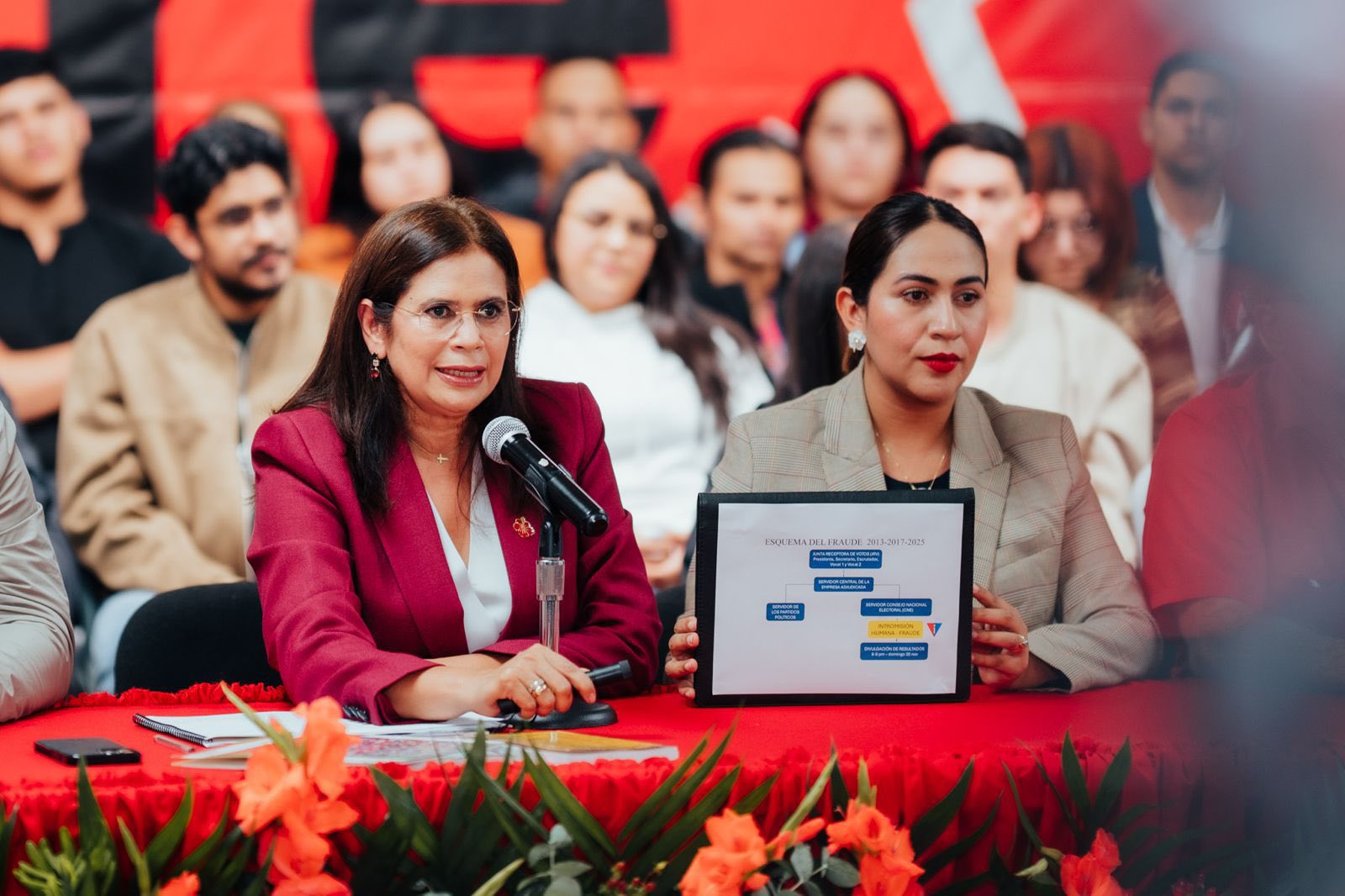
A little over four months before the general elections on November 30, the Honduran ruling party faces growing public delegitimization. The Libertad y Refundación (LIBRE) party, which has led the government since 2022, has been the target of accusations by the political opposition, business organizations, and sectors of civil society, which denounce alleged maneuvers to alter the electoral process and cling to power amid a sharp drop in the polls.
Decline in voting intentions and loss of confidence
Recent surveys, like those performed by Pro Encuestas and TResearch, show a continuous drop in support for Rixi Moncada’s bid for the presidency. Initially the frontrunner, Moncada has now been surpassed by nationalist Tito Asfura and liberal Salvador Nasralla in the surveys, placing her in third position.
Analysts point to a mix of factors for this downturn: accusations of corruption in public administration, internal discord within the ruling party, weak economic results, and an increasing public view of government management lacking transparency. The dwindling popular backing has aligned with a tougher political discourse from the executive branch and indications of institutional strain that have triggered warnings in different sectors.
Suspicions about the electoral process and institutional control
One of the main sources of controversy is the ruling party’s refusal to allow manual verification of votes, a common practice in previous elections that serves as a cross-checking mechanism for the digitization of results. The opposition and independent organizations warn that eliminating this review could facilitate irregularities and hinder citizen and international audits.
In addition, there have been reports of actions aimed at hindering the implementation of the Preliminary Election Results Transmission System (TREP), which is key to the transparency of the vote count. Tensions have intensified within the National Electoral Council (CNE) itself, where councilors such as Cosette López and Ana Paola Hall have denounced pressure and attempts to block their work.
Business organizations and opposition representatives interpret these measures as part of a strategy to consolidate institutional control of the electoral process, limit external oversight, and guarantee the ruling party room for maneuver in the event of a defeat at the polls.
Claims of political biases and an atmosphere of dispute
The holding in Tegucigalpa of a session of the São Paulo Forum, with the participation of delegations from left-wing governments in the region, reignited the debate on the international alliances of the LIBRE party. Critical voices pointed out that these links with the Venezuela-Cuba-Nicaragua axis could be aimed at replicating models of governance that prioritize the concentration of power and restrict spaces for democratic participation.
Simultaneously, critics like Eduardo Facussé, who previously headed the Honduran Council of Private Enterprise (COHEP), have cautioned about the potential introduction of a “Venezuela Plan.” This plan could be designed to create instability within institutions, provoke deliberate protests, and cause administrative obstructions, all of which could impede the government’s transition process.
Based on these claims, factions linked to the party in power have engaged in disruptive activities in essential venues like the National Congress and the CNE, a pattern that might undermine the electoral process’s credibility and heighten political division in the nation.
An unpredictable situation before a critical election
As the political scene in Honduras becomes more divided and the governing party sees a decline in public support, the nation moves toward elections characterized by a lack of trust, institutional strains, and doubts about democratic procedures.
Numerous groups from civil society, business communities, and political figures have emphasized the necessity for strong international oversight and systems to ensure the openness and integrity of the election process.
The current situation exposes not only the fragility of the democratic consensus in the country, but also the difficulty of channeling political competition within stable institutional margins, in a context of growing citizen disaffection and distrust of state institutions.
