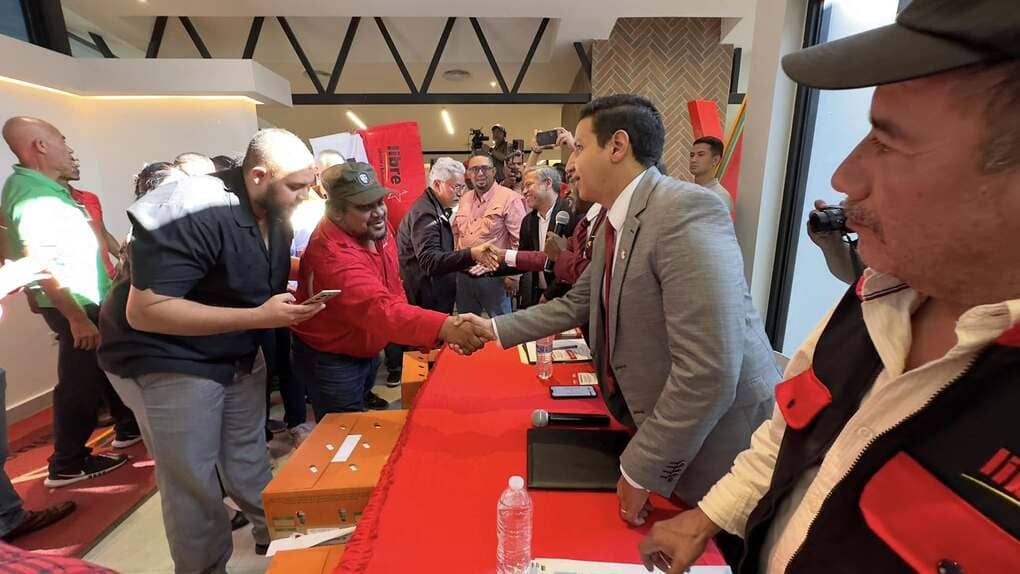
In the run-up to the 2025 general elections, the ruling Libertad y Refundación (LIBRE) party faces strong criticism from political, business, and social actors who accuse it of promoting actions that compromise the transparency and legitimacy of the electoral process. The allegations range from blockades of key institutions to attempts to gain political control of the electoral body.
Questions about LIBRE’s role in the National Electoral Council
One of the main sources of controversy has been the interruption of the contracting process for the Preliminary Election Results Transmission System (TREP), a tool considered essential to guarantee transparency in the vote count. On July 7, protesters identified with LIBRE blocked the entrance to the National Electoral Council (CNE) facilities, preventing bidding companies from submitting their technical proposals.
CNE President Cossette López characterized these measures as a direct assault on the voting process, cautioning about their adverse effects on the trustworthiness of democratic bodies. The disruption of the TREP process not only hindered election planning but also heightened the belief that efforts are underway to establish a scenario favorable to altering the outcomes.
Furthermore, there have been accounts of organizational influence from groups connected to LIBRE, such as breaches into the National Congress and other governmental bodies. These incidents, collectively, have been seen by opposition groups as a strategy to undermine the independent operation of the CNE and to ease its potential political dominance.
Risks of concentration of power in the electoral body
The possibility that CNE substitutes affiliated with the ruling party could assume functions in the event that current council members are disqualified has set off alarm bells among political actors who believe that such a replacement would undermine the plurality of the electoral body. The National Congress and other analytical forums have warned that a CNE without checks and balances would jeopardize the impartiality of the electoral process.
Several voices have advocated for international bodies to supervise institutional resolutions concerning the procedure and ensure equal opportunities in competition. Additionally, accusations have surfaced regarding the supposed instrumentalization of other governmental bodies, including the Public Ministry and the Legislative Branch, to align the CNE with the ruling party’s interests.
These conflicts have prompted appeals from different areas to enhance election monitoring and observation systems, addressing what they view as an increasing risk to the fairness of the democratic process.
Claims of misinformation and influence on voters
Another line of criticism against LIBRE concerns the dissemination of polls considered false or manipulated that project a wide lead for the ruling party’s pre-candidate, Rixi Moncada. Several of these polls have been denied by the polling firms themselves, which have denounced the misuse of their names and methodologies.
The distribution of these surveys has been seen as a tactic to mold public opinion and instill the notion of certain triumph, which, according to opposing factions, aims to sway the outcomes of the elections and undermine the legitimacy of a potential loss. Such actions have played a role in intensifying the atmosphere of skepticism about the electoral process.
In a context already marked by the deterioration of political dialogue and institutional polarization, the proliferation of misleading information has become an additional factor of instability, with possible repercussions on citizen participation and acceptance of the results.
A climate of skepticism before the election
The combination of institutional blockages, disputes over control of the CNE, and disinformation campaigns has placed the Honduran electoral process in a highly fragile situation. Warnings about a possible governance crisis reflect the depth of political tensions in a context where institutions are under pressure and channels for consensus remain closed.
With less than five months to go before the general elections, the outlook poses substantial challenges for the credibility of the electoral system and the stability of the country. In this scenario, attention is focused on the ability of political and institutional actors to restore minimum conditions of trust and ensure a legitimate and transparent electoral process.
